ramtester · the original

Insert the chip.
Get a straight answer.

A fast, open-source memory tester for vintage DRAM and SRAM — from C64 and Amiga to Apple II and ZX Spectrum. Built and maintained by the developer who designed it.

THE ORIGINAL Designed and built by its developer — every firmware update comes from the person who built it.
RAM Tester testing a chip in the ZIF socket, showing a PASS result on the OLED display
> 514258 · 256K×4
pin check ...... ok
retention ...... ok
static col ..... ok
RESULT: PASS
200+
units sold worldwide
16
RAM types · DIP, ZIP & SOJ
<2 s
full 4164 test
GPLv3
100% open source
how it works

One chip. One switch. One clear result.

Insert a chip, set the DIP switch to the pin count, hit reset. The tester auto-detects the type and runs the complete diagnostic suite — no menus, no algorithm picking, no datasheet lookups. The verdict shows on the OLED, or as a plain green/red LED.

Standard chip tested in the ZIF socket

Standard DIP & ZIF

16/18/20-pin chips like 4164, 41256 or 514256 — straight into the socket.

ZIP package chip being tested

20-pin ZIP

ZIP packages such as 514256 or 514400 tested directly — no adapter needed.

Self-test mode showing a QR code on the display

Built-in self-test

Verify the tester's own hardware. A QR code links straight to the docs.

in action

Operation is dead simple.

No manual, no prior knowledge. Five moves — the tester does the rest automatically.

pick the RAM chipset the pin countdrop it in the socketplug indone

Full hands-on walkthrough · 14 min

why this one

Thorough by default, not by configuration.

Other testers ask you to choose a test mode. This one just runs them all — and tells you exactly what it found.

01

Zero configuration

Set the pin count, that's it. The chip type, socket and full algorithm suite are handled for you.

02

Fast

A full 4164 in under 2 seconds. Work through a whole tray of chips in minutes, not an afternoon.

03

Comprehensive

Patterns, crosstalk, address-line checks, real retention timing, CAS-before-RAS refresh, fast page & static column.

04

Repeatable

Same chip, same diagnosis — every time. No marketing knobs, no theatrics, just a deterministic verdict.

05

Safe

Short-circuit protection, current limiting and ground-short detection — visible right there in the schematic.

06

Fully open source

Hardware, firmware and schematics on GitHub under GPLv3. Every claim on this page is in the code.

real fault detection

It doesn't just say “bad.” It says why.

These are simulated fault scenarios that show what the tester actually catches — from hard shorts to high-impedance soft faults.

Data output pin shorted to Vcc
Dout → VccWrite / verify mismatch
Two address pins shorted together
Address pins shortedBit-independence check
Address pin stuck at a fixed level
Address pin stuckFound via address sweep
Pin connected to ground through a 4.7k resistor
Soft fault · 4.7k → GNDEven high-impedance faults
A 4116 chip tested on the 4116 adapter board
4116 via adapterMulti-voltage 4116 / 4027
A 3732 chip that also works as a 4532
Half-good 4164Usable as 3732 or 4532
A fully functional 4164 mislabeled as a 3732 or 4532
Mislabeled 4164Actually a full working 4164
NEW · MORE COVERAGE

DRAM didn't stop at DIP.

Optional adapter boards extend the tester into packages a standard socket can't reach — including surface-mount SOJ pulls and ZIP variants you won't find on other testers.

multi-voltage

4116 adapter

Generates +12 V / −5 V on board to safely test classic 16-pin DRAM. Available bundled or standalone.

41164027
surface-mount

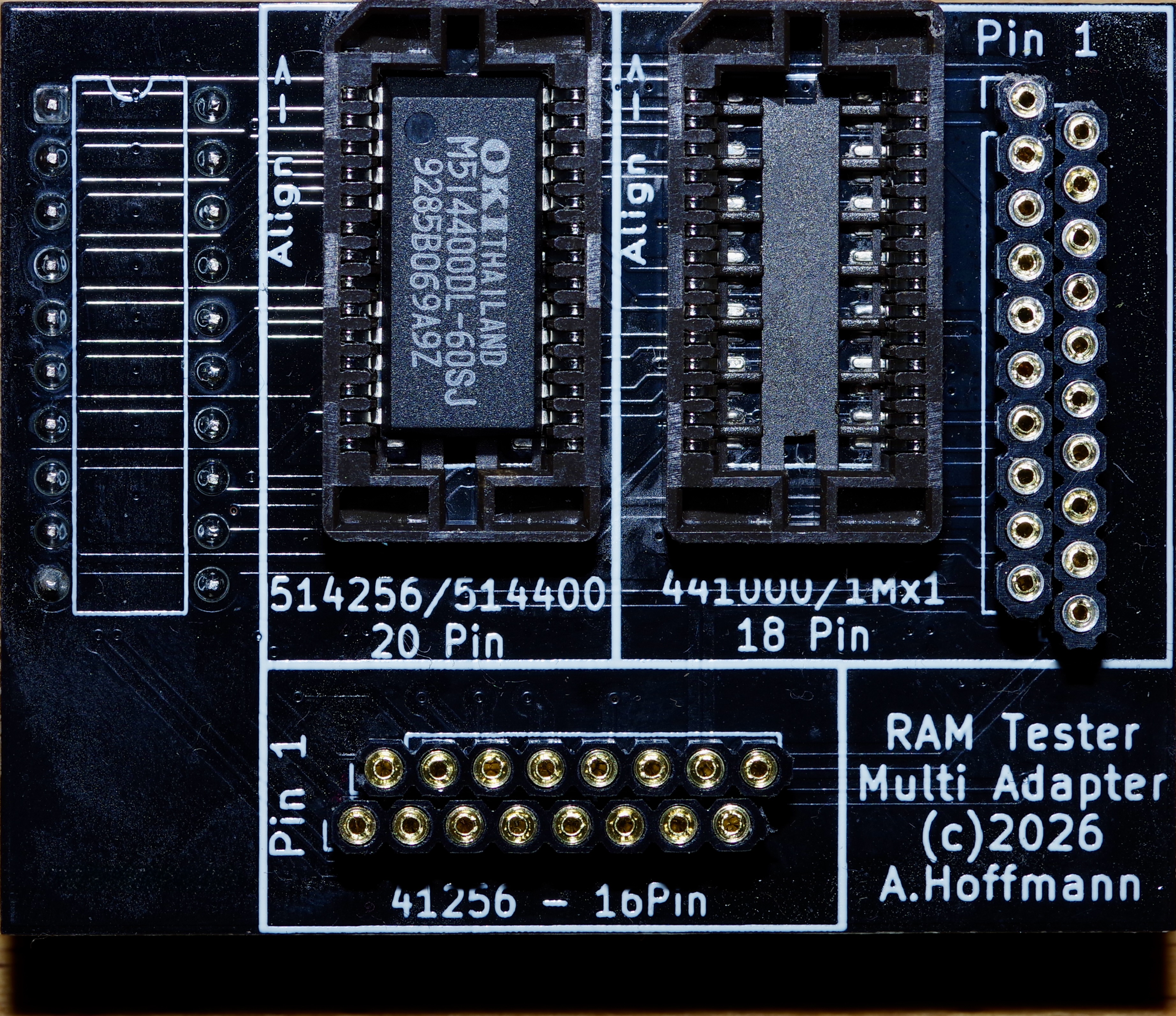
SOJ adapter

Test SOJ memory you've desoldered from Amiga and later boards — directly, without reflowing it back. The package the “professional” closed boxes leave out.

SOJ adapter for the RAM Tester — tests desoldered surface-mount J-lead DRAM (514256, 514258, 514400, 514402, 441000) directly, no reflow needed
514400514402514256514258441000
zip pinouts

ZIP adapters

The less-common ZIP pinouts, covered. Two dedicated adapters for the chips other testers simply skip.

441000 ZIP41256 ZIP
supported chips

Coverage & test times.

Times are for the complete test — patterns, retention, CAS-before-RAS refresh, fast page & static column, and address-line verification. Times are for the current firmware version.

ChipCapacityPinsTest timeNotes
40274K × 1160.2 sMulti-voltage — via 4116 adapter
411616K × 1160.5 sMulti-voltage — via 4116 adapter
481616K × 1160.7 s
3732 / 453232K × 1161.8 sHalf-good 4164 chips
416464K × 1161.8 sC64, ZX Spectrum & many more
41256 / 41257256K × 1167.5 s41257 uses Nibble Mode
441616K × 4181.7 s
446464K × 4185.2 s
511000 / 4110001M × 11823.8 sDIP · SOJ via adapter · ZIP needs adapter
514256 / 514258256K × 4203.5 sDIP & ZIP · 514258 = Static Column · SOJ via adapter
514400 / 5144021M × 42012.0 sDIP & ZIP · 514402 = Static Column · SOJ via adapter
21141K × 4 SRAM180.4 sInsert rotated 180° — see manual

SOJ packages (514400, 514402, 514256, 514258, 441000) and the 441000 / 41256 ZIP pinouts run through the optional adapter boards above. Times are for the current firmware version. Manufacturer part numbers (HM…, MB…, µPD…, TMS…, MSM… and others): see compatibility.md.

honest by design

The part the glossy listings leave out.

A diagnostic tool is only as trustworthy as what it admits. So here's the straight version.

We don't call it “professional.”

No microcontroller-based DRAM tester runs at true TTL thresholds — this one included. Marginal chips that fail in a real machine can still pass on any tester in this class. Calling a hobbyist board “professional” is a word, not a measurement.

What you get instead: every test on this page is in the source. Read it, verify it, or change it. That's a stronger promise than an adjective.

Switched power? Here's the data.

Thousands of chips tested across every supported type — not one damaged. Inserting 5 V-level DRAM into a ZIF socket simply isn't what kills these parts.

Prefer not to hot-swap? Unplug USB before changing chips — the tester runs a full self-check on every power-up regardless. Protection you can see in the schematic beats protection you have to take on faith.

where to buy

Straight from the developer.

Pre-assembled SMD board, fully tested — you solder the through-hole parts in about 30 minutes. The 4116, SOJ and ZIP adapters are available bundled or standalone at every channel.

ships to the EU & worldwide — direct from Switzerland outside the EU — UK, USA & rest of world
EU shipping & import costs. EU orders ship directly from Switzerland via Tindie, AmiBay or email. There is no IOSS number, so EU import VAT (and any handling fee) is charged on delivery rather than at checkout — please factor that in. The eBay and Lectronz listings cover the UK, USA and the rest of the world, but do not ship to the EU. Buying direct from the developer funds the next firmware release — you support the project, not a reseller.
no black box

Open source isn't a feature here. It's the whole point.

All schematics, PCB files, firmware and test algorithms live on GitHub under GPLv3. Any claim on this site can be confirmed by reading the code — limitations included. Want to build it yourself? The Gerbers for both the SMD and through-hole versions are right there too. Pull requests, issues and forks welcome.

License
Hardware — CERN-OHL-S v2
Firmware — GPL v3

Build it · improve it · sell it
— just keep it open and
point people back here.